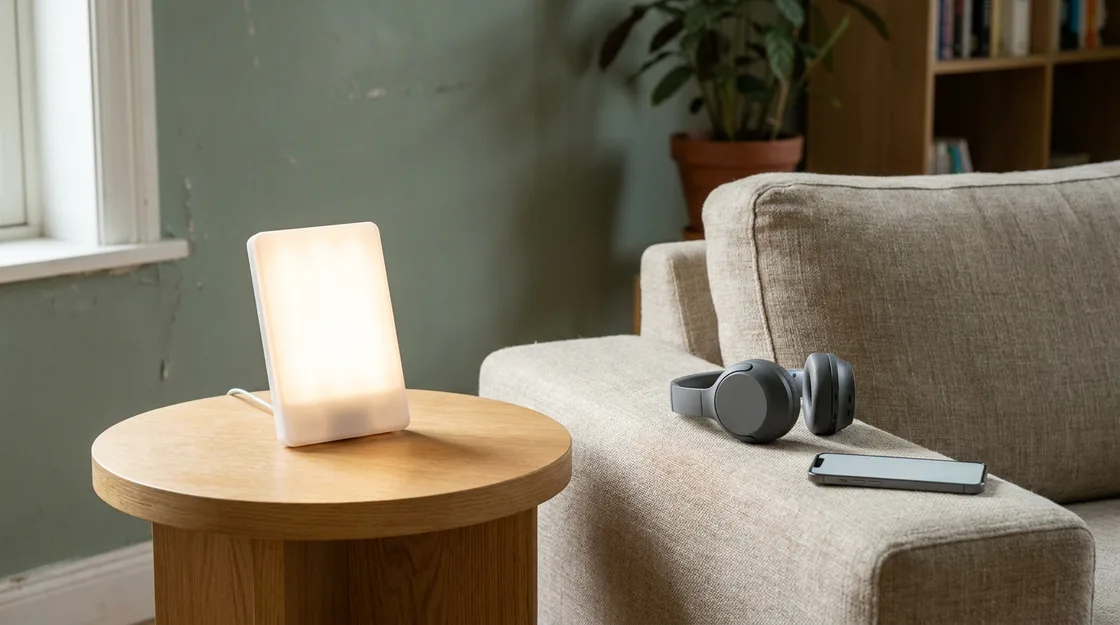
Search "40 Hz light therapy device" and look at who answers. Nearly every result either sells a lamp, is a scientific paper, or is a forum thread from someone caring for a parent with Alzheimer's, asking whether the lamp is worth it. Not one answers what you actually typed: do you need the device at all, or is audio enough?
This site doesn't sell a lamp, so we can. Every price and claim below was taken from each manufacturer's own page on September 16, 2026 — check before you buy; at least one changed last month.
What the trials actually required (not what the ads say)
The study every lamp seller cites is OVERTURE, published in Frontiers in Neurology in 2024 by Cognito Therapeutics. Read the methods and three things stand out.
The device was light and sound, together. The unit, CogTx-001, "includes an eye-set for visual stimulation, headphones for auditory stimulation, and a handheld controller." Not a lamp. Not a track. Both, synchronized.
The dose was an hour a day, every day, for six months, at home. Seventy-six people with mild-to-moderate Alzheimer's were randomized — 47 to the device, 29 to a sham; 74 started treatment, and 53 finished.
The primary outcome did not separate the groups. On the pre-registered main measure (MADCOMS), p = 0.6825. That sentence is missing from nearly every page citing this trial as a success. What moved were secondary measures: 76% less decline on MMSE, 77% less on daily-living function, 69% less loss of total brain volume — nominally significant, in a trial the authors themselves say "was not statistically powered to evaluate potential efficacy outcomes." Amyloid on PET scans: no difference. The famous plaque-clearing result is a mouse result. In people, the plaques didn't move.
For the background rather than the fine print, our main guide covers what 40 Hz research shows and doesn't. And "one hour a day" is the number that decides everything else on this page — including how long a healthy adult should listen, which we've covered separately.
Light or sound? What happens when someone measures it
In mice, MIT's team tested light alone, sound alone, and both together — all did something. In people, the published trials used light and sound together, and none has isolated sound-only against light-only on a clinical outcome. So the honest answer comes from measuring the brain's response directly.
In 2025, a team recorded 16 cognitively healthy adults with magnetoencephalography during 40 Hz stimulation (Alzheimer's & Dementia). Their conclusion, verbatim:
"Induced 40Hz oscillations are maximal with synchronized 40Hz light and sound stimulation as compared to light or sound stimulation alone."
Pushed out of phase, the 40 Hz response dropped in both auditory and visual cortex. Light works, sound works, both together work more — and only when synchronized.
Two more results keep this from becoming a sales pitch for lamps.
Light alone has already failed a human test. In 2018 (International Journal of Alzheimer's Disease), six patients used a 40 Hz lamp with no sound, two hours a day, for ten days: "No significant decrease of PiB SUVR values was detected." Buying the light channel is not buying a result.
And the one study of 40 Hz and attention in healthy adults — 62 people aged 18–40, published in 2025 — used LEDs and earbuds together for a full hour during a vigilance test. Accuracy was 98.4% under 40 Hz versus 94.7% with constant light and 94.5% with random flicker; reaction times were 10–11% faster. The authors call these acute effects in young, healthy people. It is the closest evidence to "40 Hz for focus" that exists: audiovisual, and an hour long. All of it is specific to 40 Hz — theta is a different story, compared separately.
What you can buy, and what it costs (verified September 16, 2026)
No page in the search results prices both sides. Here they are, from each maker's own site.
Sound only (through the ears)
| Product | Price | What it is |
|---|---|---|
| myNoise 40 Hz gamma generator | $0 (optional donation) | Browser-based, no sign-up |
| The Genius Song | $39, one-time | Downloadable track plus bonuses, 90-day money-back guarantee |
| Clarity 40Hz Sound Player | $49.99 | Small hardware player from the company that makes the Clarity lamps |
Visible flickering light (through the eyes) — the category the trials used
| Product | Price | Returns / warranty |
|---|---|---|
| AlzLife app | $0, iOS and Android | Light and sound through the phone screen — needs a 90 Hz display (see below) |
| Clarity 40Hz bulb | $59.99 | 30-day returns |
| Clarity 40Hz lamp | $169.99 | 30-day returns |
| Clarity light + sound bundle | $179.99 | 30-day returns |
| BEACON40 | $274 (single) to $434 (pair), up to $694 by model | Not stated on the pages we read |
| OptoCeutics EVY LIGHT | $2,999 or $1,999 — see below | 90-day full refund, free return shipping; 10-year warranty |
A different mechanism entirely
| Product | Price | Why it's not the same thing |
|---|---|---|
| Vielight Neuro Gamma 4 | $1,799 | Near-infrared (810 nm) LEDs on the scalp and inside the nose, pulsed at 40 Hz. You see no flicker; the claimed mechanism is mitochondrial, not sensory entrainment. 80% refund within 6 months; 24-month warranty; not FDA-cleared |
About that EVY price: as of September 16, 2026, OptoCeutics lists EVY LIGHT at $2,999 on its shop page, while its own product page still shows $1,999 and its interest-free payment plans (4 × $499.75, or 12 × $166.60) both add up to $1,999. Check the checkout total before you commit — the company's own pages don't agree with each other today.
Two things the table makes visible. First, nothing exists between roughly $700 and $1,700. Second, OptoCeutics' own "Gamma Light Therapy Reviews" page ranks six devices, including its own, and picks EVY — without saying anywhere that it makes EVY. In fairness, the company has more published research than any audio product here (Agger et al., 2022 and 2023, a randomized, double-blind pilot that found the device "safe and well-tolerated"), and its site calls EVY "a general wellness product" that is "still considered experimental."
If you go the sound route, whether you need headphones depends on the audio format — answered separately.
The device from the best trial isn't for sale
The CogTx-001 behind the OVERTURE numbers is now called Spectris. You cannot buy it in 2026. It holds FDA Breakthrough Device status (2021), its pivotal HOPE trial — 670 people, 70 sites — is fully enrolled with results expected now, and Cognito plans a prescription launch in 2027. The company's own cost-effectiveness modeling assumed a price of $44,000 to $108,000.
So the device the strongest trial actually used isn't for sale to you at any price. What is for sale ranges from a free phone app to a $2,999 lamp — every one a different product from the one in the study.
The $0 way to try light and sound first
AlzLife is a free iOS/Android app that delivers 40 Hz light and sound through your phone's own screen and speaker, with cognitive exercises alongside. It cites its supporting studies and — unlike several lamp stores — carries a seizure warning.
It also explains something no lamp maker mentions. To flash at 40 Hz cleanly, a screen has to refresh at 90 Hz or higher. 40 doesn't divide evenly into a standard 60 Hz display, so on those phones the app drops to 30 Hz, which the developer says "may be less effective." Check your phone's refresh rate first.
For sound alone, myNoise's gamma generator is free in the browser. Between the two, you can try both channels for nothing before a four-figure purchase.
A short note on flickering light (the rest lives elsewhere)
Photosensitive epilepsy is most easily provoked by flicker between 15 and 25 Hz, with documented risk from roughly 3 to 60 Hz (Epilepsy Society). So 40 Hz isn't the worst case, but it sits inside the range — the US Section 508 accessibility standard tells screen designers to avoid flicker from 2 to 55 Hz. A 2026 review in Brain Sciences puts it plainly:
"Photic stimulation at any frequency carries a low but non-zero risk of triggering seizures in individuals with photosensitive epilepsy."
That is the stated reason OptoCeutics built "invisible spectral flicker" — alternating two shades of white so the 40 Hz is there but the strobe isn't. Audio has no flicker at all.
The math, without the promise
A $2,999 lamp is about 77 times the price of a $39 download. That ratio only means something if you know what you're buying with the difference: a visible-flicker light channel, a 90-day full refund, a 10-year warranty — and the same requirement to sit with it for an hour a day for months. Audio alone has never been shown to do what light-and-sound did in those trials. What it has is a much smaller bill for finding out whether you'll stick with a daily habit at all.
The 2026 Brain Sciences review applies one rule to both ends of the ladder: "Single-session entrainment does not reliably yield cognitive gains." That covers a seven-minute track and a $2,999 lamp equally. Nobody buys a shortcut. What the $39 product actually includes — and the checkout upsells — is covered in full separately.
Where this site stands
Full disclosure: this site earns a commission on one $39 audio product and nothing at all on any device on this page. That's a much smaller incentive than the one behind a $2,999 lamp — which is exactly why every price here was taken from the manufacturer's own page, with the date attached, so you can check them yourself.
Who should do what
A caregiver deciding for someone with diagnosed Alzheimer's or MCI. The device with the strongest trial isn't sold yet, and that trial's primary outcome didn't separate. The conversation is with a neurologist, not a checkout page. If you buy anyway, the 90-day full refund is the number that matters most.
You want to try light plus sound without spending anything. The free app — after checking that your screen runs at 90 Hz or more.
You will genuinely do an hour a day for months, and have the budget. Then a device with a real return window makes sense — and the trials say synchronized light and sound, not a lamp.
You want help focusing at work, with no diagnosis. The closest evidence is the 2025 attention study: audiovisual, one hour, healthy adults. The cheapest way to find out whether you'll keep a daily habit is the sound side, from $0.
Frequently asked questions
Do I need the light, or is 40 Hz audio enough?
No human trial has tested audio alone against light alone on a clinical outcome. In direct brain measurements (MEG, 2025), synchronized light and sound produced the strongest 40 Hz response; either alone produced less. Audio hasn't been shown to do what light-and-sound did in the Alzheimer's trials — it is the cheaper way to test whether you'll keep a daily habit.
How much does a 40 Hz light therapy device cost?
As of September 16, 2026: a free app (AlzLife), Clarity lamps from $59.99 to $179.99, BEACON40 from $274, Vielight at $1,799 (a different, near-infrared mechanism), and OptoCeutics EVY at $1,999 or $2,999 depending on which of the company's own pages you read.
Can I use a free app or a flickering screen instead of a lamp?
Yes. AlzLife delivers 40 Hz light and sound through a phone, free. The catch is the display: it needs a 90 Hz or faster refresh rate. On a standard 60 Hz screen the app falls back to 30 Hz, which its developer says may be less effective.
Is 40 Hz flickering light safe for my eyes, or can it trigger a seizure?
Photosensitive epilepsy is most sensitive to 15–25 Hz flicker, but documented risk runs from about 3 to 60 Hz, so 40 Hz is inside the range. Audio doesn't flicker. The trials excluded people with a seizure history, so talk to a neurologist first.
Is the device the studies used the same one I can buy?
No. The OVERTURE trial used Cognito's CogTx-001, now called Spectris — investigational, not for sale, and expected to launch by prescription in 2027. Every device on sale today is a different product.
- Cognito Therapeutics — OVERTURE trial: 40 Hz sensory stimulation in mild-to-moderate Alzheimer's disease (NCT03556280). Frontiers in Neurology, 2024. PMC10957179
- MEG evidence that synchronized 40 Hz light and sound produce the strongest gamma response, versus either alone. Alzheimer's & Dementia, 2025. PMC12741936
- 40 Hz audiovisual stimulation and attention/vigilance in healthy adults aged 18–40. 2025. PMC12407815
- Light-only 40 Hz stimulation (no sound), 10 days: no significant change in PiB SUVR. International Journal of Alzheimer's Disease, 2018. PMC6091362
- Review of 40 Hz sensory entrainment research, including single-session limits and photosensitive-seizure risk. Brain Sciences, 2026. PMC13511712
- MIT Picower Institute — institutional notes on light-alone, sound-alone and combined 40 Hz stimulation in mouse models (GENUS). picower.mit.edu
- OptoCeutics — EVY LIGHT shop page ($2,999) and product page ($1,999), checked September 16, 2026. optoceutics.com/shop/evy · optoceutics.com/this-is-evy-light
- Vielight — Neuro Gamma 4 product page. vielight.com
- BEACON40 — product and pricing page. beacon40.com
- AlzLife — free 40 Hz light and sound app. alz.life
- myNoise — free 40 Hz gamma generator. mynoise.net
- Epilepsy Society — photosensitive epilepsy and flicker frequency risk range. epilepsysociety.org.uk
- Section 508 — accessibility flicker guidance (2–55 Hz). section508.gov
This article is educational and is not medical advice. Prices, specifications and trial details were verified against each company's own page on the date noted and can change. If you or someone you care for has diagnosed Alzheimer's disease or mild cognitive impairment, talk to a neurologist before choosing a device.